
Components#
Components classes are related via the inheritance diagram,
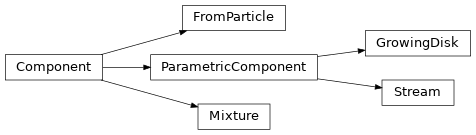
For each subclass, this API lists public methods are new or newly re-implemted for that subclass e.g. a docstring for evaluate_ybar appears for Component, ParametricComponent and Mixture as they have their own implementations, while it does not appear for FromParticle which inherits evaluate_ybar from Component.
Component#
- class popkinmocks.components.Component(cube=None, log_p_tvxz=None)#
A galaxy component specified by the (log) joint density p(t,v,x,z)
Sub-classes of Component correspond to specific choices of p(t,x,v,z). Main methods are get_p to evaluate probability functions and get_mean, get_variance, get_skewness, get_kurtosis to get moments.
- Parameters:
cube – a pkm.mock_cube.mockCube.
log_p_txvz (array) – 5D array of natural log of mass-weighted probabilty density i.e. log p(t,v,x1,x2,z)
- dill_dump(fname, direc=None)#
Save the component using dill
Makes the directory if it does not already exist. Saves component there using dill.
- Parameters:
fname (string) – filename
direc (string, optional) – directory name
- evaluate_ybar(batch='none')#
Evaluate the datacube for this component
This evaluates the full integral assuming a 5D joint density i.e.:
\[\bar{y}(x, \omega) = \int S(\omega-v ; t,z) p(t,v,x,z) dv dt dz\]where omega is log lambda. This integral is a convolution over velocity v, which we evaluate using FFTs. FFTs of SSP templates are stored in`ssps.FXw` while FFTs of (the velocity part of) the density p(t,v,x,z) are evaluated here. Sets the result to self.ybar.
- Parameters:
batch (bool, optional) – evaluate datacube row by row, default False
- get_central_moment(which_dist, j, light_weighted=False)#
Get central moment of a 1D distribution
See full docstring of self.get_mean for restrictions on which_dist and meaning of output.
- Parameters:
which_dist (string) – which distribution to take central moment of.
j (int) – moment order
light_weighted (bool) – whether to return light-weighted (True) or mass-weighted (False) quantity
- Returns:
the central moment or conditional central moment
- Return type:
float/array
- get_correlation(which_dist, light_weighted=False)#
Get correlation or conditional correlation of a 2D distribution
\[\mathbb{Cor}(a,b|c) = \frac{\mathbb{Cov}(a,b|c)}{\sqrt{\mathbb{Var}(a|c)\mathbb{Var}(b|c)}}\]- Parameters:
which_dist (string) – a bivariate distribution to take covariance of
light_weighted (bool) – whether to return light-weighted (True) or mass-weighted (False) quantity
- Returns:
the correlation or conditional correlation
- Return type:
float/array
- get_covariance(which_dist, light_weighted=False)#
Get covariance or conditional covariance of a 2D distribution
For two variables a,b out of (‘t’, ‘v’, ‘x’, ‘z’) get their covariance
\[\mathbb{Cov}(a,b)=\int p(a,b)(a-\mathbb{E}(a))(b-\mathbb{E}(b))\;da\;db\]or conditional covariance given a third variable c,
\[\mathbb{Cov}(a,b|c)=\int p(a,b|c)(a-\mathbb{E}(a|c))(b-\mathbb{E}(b|c))\;da\;db\]where integrals estimated via summation over discretisation bins in a/b.
- Parameters:
which_dist (string) – a bivariate distribution to take covariance of
light_weighted (bool) – whether to return light-weighted (True) or mass-weighted (False) quantity
- Returns:
the covariance or conditional covariance
- Return type:
float/array
- get_excess_kurtosis(which_dist, light_weighted=False)#
Get excess kurtosis of a 1D distribution
See full docstring of self.get_mean for restrictions on which_dist and meaning of output.
- Parameters:
which_dist (string) – which distribution to take ex-kurtosis of.
light_weighted (bool) – whether to return light-weighted (True) or mass-weighted (False) quantity
- Returns:
the ex-kurtosis or conditional ex-kurtosis
- Return type:
float/array
- get_kurtosis(which_dist, light_weighted=False)#
Get kurtosis of a 1D distribution
See full docstring of self.get_mean for restrictions on which_dist and meaning of output.
- Parameters:
which_dist (string) – which distribution to take kurtosis of.
light_weighted (bool) – whether to return light-weighted (True) or mass-weighted (False) quantity
- Returns:
the kurtosis or conditional kurtosis
- Return type:
float/array
- get_log_p(which_dist, density=True, light_weighted=False)#
Evaluate log probability functions for this component
Evaluate marginal or conditional distributions over stellar age t, 2D position x, velocity v and metallicity z. The argument which_dist specifies which distribution to evaluate, where an underscore (if present) represents conditioning e.g.:
which_dist = ‘tv’ –> p(t,v),
which_dist = ‘tz_x’ –> p(t,z|x) etc
Variables in which_dist must be provided in alphabetical order (on either side of the underscore if present).
- Parameters:
which_dist (string) – valid string for the distribution to evaluate
density (bool) – whether to return probabilty density (True) or the volume-element weighted probabilty (False)
light_weighted (bool) – whether to return light-weighted (True) or mass-weighted (False) quantity
- Returns:
- the desired distribution. Array dimensions correspond to the
order of variables as provided in which_dist string e.g. which_dist = tz_x returns p(t,z|x) as a 4D array with dimensions corresponding to [t,z,x1,x2].
- Return type:
array
- get_mean(which_dist, light_weighted=False)#
Get mean or conditional mean of a 1D distribution
The which_dist string specifies which distribution to mean. If which_dist contains no underscore, this returns the mean of the appropriate marginal distribution. If which_dist contains an underscore, this returns the mean of the conditional distribution e.g.:
which_dist = ‘v’ returns E(v) = int v p(v) dv
which_dist = ‘v_x’ returns E(v|x) = int v p(v|x) dv
Only works for distributions of one argument.
- Parameters:
which_dist (string) – which distribution to mean. See full docstring.
light_weighted (bool) – whether to return light-weighted (True) or mass-weighted (False) quantity
- Returns:
- if the variable to mean is t, v or z, returns an array
with shape equal to the shape of the conditioners e.g. which_dist = ‘v_tz’ returns array shape (nt, nz) and a float if conditional. For x, the returned array has extra initial dimension of size 2 for the 2 spatial dimensions.
- Return type:
float/array
- get_noncentral_moment(which_dist, j, mu, light_weighted=False)#
Get noncentral moment of 1D distributions
See full docstring of self.get_mean for restrictions on which_dist and meaning of output.
- Parameters:
which_dist (string) – which distribution to take central moment of.
mu (array) – center about which to take moment about, with shape broadcastable with conditioners of which_dist (if present)
j (int) – moment order
light_weighted (bool) – whether to return light-weighted (True) or mass-weighted (False) quantity
- Returns:
the central moment or conditional central moment
- Return type:
float/array
- get_p(which_dist, density=True, light_weighted=False)#
Evaluate probability functions for this component
Evaluate marginal or conditional distributions over stellar age t, 2D position x, velocity v and metallicity z. The argument which_dist specifies which distribution to evaluate, where an underscore (if present) represents conditioning e.g.:
which_dist = ‘tv’ –> p(t,v),
which_dist = ‘tz_x’ –> p(t,z|x) etc
Variables in which_dist must be provided in alphabetical order (on either side of the underscore if present).
- Parameters:
which_dist (string) – valid string for the distribution to evaluate
density (bool) – whether to return probabilty density (True) or the volume-element weighted probabilty (False)
light_weighted (bool) – whether to return light-weighted (True) or mass-weighted (False) quantity
- Returns:
- the desired distribution. Array dimensions correspond to the
order of variables as provided in which_dist string e.g. which_dist = tz_x returns p(t,z|x) as a 4D array with dimensions corresponding to [t,z,x1,x2].
- Return type:
array
- get_skewness(which_dist, light_weighted=False)#
Get skewness of a 1D distribution
See full docstring of self.get_mean for restrictions on which_dist and meaning of output.
- Parameters:
which_dist (string) – which distribution to take skewness of.
light_weighted (bool) – whether to return light-weighted (True) or mass-weighted (False) quantity
- Returns:
the variance or conditional skewness
- Return type:
float/array
- get_variance(which_dist, light_weighted=False)#
Get variance of a 1D distribution
See full docstring of self.get_mean for restrictions on which_dist and meaning of output.
- Parameters:
which_dist (string) – which distribution to take variance of.
light_weighted (bool) – whether to return light-weighted (True) or mass-weighted (False) quantity
- Returns:
the variance or conditional variance
- Return type:
float/array
- save_numpy(fname, yobs=None, direc=None)#
Save the component in npz format. Deprecated for dill_dump.
Saves various quantities about the cube and component in a npz file. The density p(t,v,x,z) is rearranged to p(x,v,z,t) for backward compatibility with v0.0.
- Parameters:
fname (string) – filename
direc (string, optional) – directory name
yobs (array, optional) – the observed datacube, i.e. including noise
FromParticle#
- class popkinmocks.components.FromParticle(cube, t, v, x1, x2, z, mass_weights=None)#
A component from star particle data from simulations
This is a wrapper around base.Component which makes a 5D histogram of the particle data in (t, v, x, z) space. Particles should be mass-weighted, else provide the mass_weights argument which should. All particle data should be provided as 1D arrays of the same length and ordering.
- Parameters:
cube – a pkm.mock_cube.mockCube.
t (array) – ages of star particles (Gyr)
v (array) – line-of-sight velocities of star particles (km/s)
x1 (array) – x1 position of star particles (units consistent with cube)
x2 (array) – x2 position of star particles (units consistent with cube)
z (array) – metallicty of star particles ([M/H])
mass_weights (array) – optional, provide if particles are not equal-mass
ParametricComponent#
- class popkinmocks.components.ParametricComponent(cube=None, center=(0, 0), rotation=0.0)#
Abstract class for parametrised galaxy components
The mass-weighted density factorises as
\[p(t,x,v,z) = p(t) p(x|t) p(v|t,x) p(z|t,x)\]where:
p(t) : beta distribution (see set_p_t),
p(x|t) : function to be implemented in subclass’s set_p_x_t method
p(v|t,x) = Normal(v ; mu_v(t,x), sig_v(t,x)) where subclasses provide specific implementations in their set_mu_v and set_sig_v methods,
p(z|t,x) = Normal(z ; mu_z(t, t_dep(x)), sig_z(t, t_dep(x))) i.e. chemical enrichment depends on a spatially varying depletion timescale t_dep(x) to be implemented in the set_t_dep method of subclass.
The functions mu_z(t,t_dep) and sig_z(t,t_dep) are from equations 3-10 of Zhu et al. 20.
- Parameters:
cube – a pkm.mock_cube.mockCube.
center (x0,y0) – co-ordinates of the component center.
rotation – angle (radians) between x-axes of component and cube.
- evaluate_chemical_enrichment_model(t_dep)#
Evaluate chemical enrichment model for a single t_dep
Hacky wrapper around self.evaluate_chemical_enrichment_model
- evaluate_chemical_enrichment_model_base(t_dep)#
Evaluate chemical enrichment model for a t_dep(x)
Evaluates the chemical evolution model defined in equations 3-10 of Zhu et al 2020, parameterised by a spatially varying depletion timescale created by set_t_dep.
- evaluate_ybar(batch='none')#
Evaluate the datacube for this component
Evaluate the integral
\[\bar{y}(x,\omega) = \int S(\omega-v;t,z) p(t,x,z) p(v|t,x) dvdtdz\]This integral is a convolution over velocity v, which we evaluate using Fourier transforms (FT). FTs of SSP templates are stored in`ssps.FXw` while FTs of the velocity factor p(v|t,x) are evaluated using analytic expressions of the FT of the normal distribution. Sets the result to self.ybar.
- Parameters:
batch (string, optional) – one of ‘none’, ‘column’, ‘spaxel’ to evaluate datacube altogether, column-by-column or spaxel-by-spaxel
- get_beta_a_b_from_lmd_phi(lmd, phi)#
Convert from (total, mean) to (a,b) parameters of beta distribution
- Parameters:
lmd – beta distribution total parameter, lmd>0
phi – beta distribution mean parameter, 0<phi<1
- Returns:
shape parameters
- Return type:
(a,b)
- get_central_moment_v(j, mu, light_weighted=False)#
Get j’th central moment of p(v)
int (v - E(v))^j p(v) dv
- Parameters:
j (int) – order of moment
light_weighted (bool) – whether to return light-weighted (True) or
mass-weighted (False) –
- Returns:
float
- get_central_moment_v_t(j, light_weighted=False)#
Get j’th central moment of p(v|t)
int (v - E(v|t))^j p(v|t) dv
- Parameters:
j (int) – order of moment
light_weighted (bool) – whether to return light-weighted (True) or
mass-weighted (False) –
- Returns:
array size (nt,)
- get_central_moment_v_tx(j, light_weighted=False)#
Get j’th central moment of p(v|t,x)
Uses analytic formula for moments of a mixture
- Parameters:
j (int) – order of moment
light_weighted (bool) – whether to return light-weighted (True) or
mass-weighted (False) –
- Returns:
array size (nt, nx1, nx2)
- get_central_moment_v_txz(j, light_weighted=False)#
Get j’th central moment of p(v|t,x,z)
int (v - E(v|t,x,z))^j p(v|t,x,z) dv
- Parameters:
j (int) – order of moment
mu (array) – arbitrary moment center, broadcastable with (nt,nx1,nx2,nz)
light_weighted (bool) – whether to return light-weighted (True) or
mass-weighted (False) –
- Returns:
array size (nt,nx1,nx2,nz)
- get_central_moment_v_tz(j, mu, light_weighted=False)#
Get j’th central moment of p(v|t,z)
int (v - E(v|t,z))^j p(v|t,z) dv
- Parameters:
j (int) – order of moment
light_weighted (bool) – whether to return light-weighted (True) or
mass-weighted (False) –
- Returns:
array size (nt,nz)
- get_central_moment_v_x(j, light_weighted=False)#
Get j’th central moment of p(v|x)
int (v - E(v|x))^j p(v|x) dv
- Parameters:
j (int) – order of moment
light_weighted (bool) – whether to return light-weighted (True) or
mass-weighted (False) –
- Returns:
array size (nx1, nx2)
- get_central_moment_v_xz(j, mu, light_weighted=False)#
Get j’th central moment of p(v|x,z)
int (v - E(v|x,z))^j p(v|x,z) dv
- Parameters:
j (int) – order of moment
light_weighted (bool) – whether to return light-weighted (True) or
mass-weighted (False) –
- Returns:
array size (nx1,nx2,nz)
- get_central_moment_v_z(j, mu, light_weighted=False)#
Get j’th central moment of p(v|z)
int (v - E(v|z))^j p(v|z) dv
- Parameters:
j (int) – order of moment
light_weighted (bool) – whether to return light-weighted (True) or
mass-weighted (False) –
- Returns:
array size (nz,)
- get_mean_v(light_weighted=False)#
Get expectation E(v)
- Returns:
float
- get_mean_v_t(light_weighted=False)#
Get conditional expectation E(v|t)
- Returns:
array size (nt,)
- get_mean_v_tx(light_weighted=False)#
Get conditional expectation E(v|t,x)
- Returns:
array size (nt, nx1, nx2)
- get_mean_v_txz(light_weighted=False)#
Get conditional expectation E(v|t,x,z)
- Returns:
array size (nt, nx1, nx2, nz)
- get_mean_v_tz(light_weighted=False)#
Get conditional expectation E(v|t,z)
- Returns:
array size (nt, nz)
- get_mean_v_x(light_weighted=False)#
Get conditional expectation E(v|x)
- Returns:
array size (nx1, nx2)
- get_mean_v_xz(light_weighted=False)#
Get conditional expectation E(v|x,z)
- Returns:
array size (nx1, nx2, nz)
- get_mean_v_z(light_weighted=False)#
Get conditional expectation E(v|z)
- Returns:
array size (nz,)
- get_noncentral_moment_v(j, mu, light_weighted=False)#
Get j’th noncentral moment of p(v) about arbitrary center mu
int (v - mu)^j p(v) dv
- Parameters:
j (int) – order of moment
mu (float) – arbitrary moment center
light_weighted (bool) – whether to return light-weighted (True) or
mass-weighted (False) –
- Returns:
float
- get_noncentral_moment_v_t(j, mu, light_weighted=False)#
Get j’th noncentral moment of p(v|t) about arbitrary center mu
int (v - mu(t))^j p(v|t) dv
- Parameters:
j (int) – order of moment
mu (array) – arbitrary moment center, broadcastable with (nt,)
light_weighted (bool) – whether to return light-weighted (True) or
mass-weighted (False) –
- Returns:
array size (nt,)
- get_noncentral_moment_v_tx(j, mu, light_weighted=False)#
Get j’th noncentral moment of p(v|t,x) about arbitrary center mu
int v (v - mu(t,x))^j p(v|t,x) dx
- Parameters:
mu (array) – arbitrary moment center, broadcastable with (nt,nx,ny)
j (int) – order of moment
light_weighted (bool) – whether to return light-weighted (True) or
mass-weighted (False) –
- Returns:
array size (nt, nx1, nx2)
- get_noncentral_moment_v_txz(j, mu, light_weighted=False)#
Get j’th noncentral moment of p(v|t,x,z) about arbitrary center mu
int (v - mu(t,x,z))^j p(v|t,x,z) dv
- Parameters:
j (int) – order of moment
mu (array) – arbitrary moment center, broadcastable with (nt,nx1,nx2,nz)
light_weighted (bool) – whether to return light-weighted (True) or
mass-weighted (False) –
- Returns:
array size (nt,nx1,nx2,nz)
- get_noncentral_moment_v_tz(j, mu, light_weighted=False)#
Get j’th noncentral moment of p(v|t,z) about arbitrary center mu
int (v - mu(t,z))^j p(v|t,z) dv
- Parameters:
j (int) – order of moment
mu (array) – arbitrary moment center, broadcastable with (nt,nz)
light_weighted (bool) – whether to return light-weighted (True) or
mass-weighted (False) –
- Returns:
array size (nt,nz)
- get_noncentral_moment_v_x(j, mu, light_weighted=False)#
Get j’th noncentral moment of p(v|x) about arbitrary center mu
int (v - mu(x))^j p(v|x) dv
- Parameters:
j (int) – order of moment
mu (array) – arbitrary moment center, broadcastable with (nx,ny)
light_weighted (bool) – whether to return light-weighted (True) or
mass-weighted (False) –
- Returns:
array size (nx1, nx2)
- get_noncentral_moment_v_xz(j, mu, light_weighted=False)#
Get j’th noncentral moment of p(v|x,z) about arbitrary center mu
int (v - mu(x,z))^j p(v|x,z) dv
- Parameters:
j (int) – order of moment
mu (array) – arbitrary moment center, broadcastable with (nx1,nx2,nz)
light_weighted (bool) – whether to return light-weighted (True) or
mass-weighted (False) –
- Returns:
array size (nx1,nx2,nz)
- get_noncentral_moment_v_z(j, mu, light_weighted=False)#
Get j’th noncentral moment of p(v|z) about arbitrary center mu
int (v - mu(z))^j p(v|z) dv
- Parameters:
j (int) – order of moment
mu (array) – arbitrary moment center, broadcastable with (nz,)
light_weighted (bool) – whether to return light-weighted (True) or
mass-weighted (False) –
- Returns:
array size (nz,)
- get_z_interpolation_grid(t_dep_lim=(0.1, 10.0), n_t_dep=1000, n_z=1000)#
Store a grid used for interpolating age-metallicity relations
- Parameters:
t_dep_lim – (lo,hi) allowed values of depletion timescale in Gyr
n_t_dep (int) – number of steps to use for interpolating t_dep
n_z (int) – number of steps to use for interpolating metallicity
- linear_interpolate_t(f_end, f_start)#
Linearly interpolate f against t given boundary [f_start, f_end]
- Parameters:
f_end – value of f at end of disk build up i.e. more recently
f_start – value of f at start of disk build up i.e. more in the past
- Returns:
f interpolated to the t array of SSP models, set to constant values outside start/end times
- Return type:
array
- abstract set_mu_v()#
Set spatially and age dependent mean velocity
Should set an attribute self.mu_v, a 3D array of size [nt, nx1, nx2]
- set_p_t(lmd=None, phi=None, cdf_start_end=(0.05, 0.95))#
Set the mass-weighted star formation history p(t)
p(t) = Beta(t; lmd, phi), where (lmd, phi) are (total, mean) parameters. Additionally this sets self.t_pars which is used for interpolating quantities against t. Any time varying quantity (e.g. disk size) is varied between start and end times as specified by CDF p(t).
- Parameters:
lmd – beta distribution total parameter, lmd>0.
phi – beta distribution mean parameter, 0<phi<1.
cdf_start_end (tuple) – CDF values of p(t) defining start and end
up (times of disk build) –
- Returns:
Description of returned object.
- Return type:
type
- abstract set_p_x_t()#
Set the age dependent spatial density p(x|t)
Should set an attribute self.log_p_x_t 3D array of the log density of size [nx1,nx2,nt]
- set_p_z_tx()#
Set p(z|t,x) given enrichment model and spatially varying t_dep
Evaluates the chemical evolution model defined in equations 3-10 of Zhu et al 2020, parameterised by a spatially varying depletion timescale created by set_t_dep.
- abstract set_sig_v()#
Set spatially and age dependent velocity dispersions
Should set an attribute self.sig_v, a 3D array of size [nt, nx1, nx2]
- abstract set_t_dep()#
Set spatially varying depletion timescale
Should set an attribute self.t_dep, a 2D array of depletion time vs 2D position, of size [nx1, nx2] and end with self.set_p_z_tx().
GrowingDisk#
- class popkinmocks.components.GrowingDisk(cube=None, center=(0, 0), rotation=0.0)#
A growing disk with age-and-space dependent velocities and enrichments
The mass-weighted density factorises as
p(t,x,v,z) = p(t) p(x|t) p(v|t,x) p(z|t,x)
where:
p(t) : beta distribution (see set_p_t),
p(x|t) : cored power-law in elliptical radius with age-varying core-size, flattening and slope (see set_p_x_t)
p(v|t,x) = Normal(v ; mu_v(t,x), sig_v(t,x)) where mu_v resembles a rotating disk (see set_mu_v) while dispersion varies from inner to outer values (see set_sig_v)
t_dep(x) varies from inner to outer value (see set_t_dep)
- Parameters:
cube – a pkm.mock_cube.mockCube.
center (x0,y0) – co-ordinates of the component center.
rotation – angle (radians) between x-axes of component and cube.
- set_mu_v(q_lims=(0.5, 0.5), rmax_lims=(0.1, 1.0), vmax_lims=(50.0, 250.0))#
Set age/space dependent mean velocities which resemble rotating disks
Mean velocity maps have rotation-curves along x-axis peaking at v_max at r_max then falling to 0 for r->inf. Given by the equation
\[\mathbb{E}[p(v|t,r,\theta)] = \cos(\theta) \frac{Kr}{(r+rc)^3}\]where
\[r^2 = x_1^2 + \left( \frac{x_2}{q} \right)^2, \;\; \theta=\arctan \frac{qx_1}{x_2}\]Parameters K and rc are chosen to give peak velocity vmax at x_1 = rmax. The quantities q, rmax and vmax vary linearly with t between the values specified for (young, old) stars.
- Parameters:
q_lims – (young,old) value of y/x axis ratio of mu(v) equicontours.
rmax_lims – (young,old) distance of maximum velocity along x-axis.
vmax_lims – (young,old) maximum velocity.
- set_p_x_t(q_lims=(0.5, 0.1), rc_lims=(0.5, 0.1), alpha_lims=(0.5, 2.0))#
Set the density p(x|t) as cored power-law in elliptical radius
Desnities are cored power-laws stratified on elliptical radius r, r^2 = x^2 + (y/q)^2 p(x|t) = (r+rc)^-alpha where the disk axis ratio q(t), slope alpha(t) and core radius rc(t) vary linearly with t between values specified for (young, old) stars.
- Parameters:
q_lims – (young,old) value of disk y/x axis ratio
rc_lims – (young,old) value of disk core-size in elliptical radii
alpha_lims – (young,old) value of power-law slope
- set_sig_v(q_lims=(0.5, 0.1), alpha_lims=(1.5, 2.5), sig_v_in_lims=(50.0, 250.0), sig_v_out_lims=(10.0, 50), sigma_max=500.0, sigma_min=10.0)#
Set age-and-space dependent velocity dispersion maps
Dispersion maps vary as power-laws between central value sig_v_in, outer value sig_v_out, with slopes alpha. Velocity dispersion is constant on ellipses with y/x axis-ratio = q. The quantities q, alpha, sig_v_in, sig_v_out vary linearly with stellar age between values specified for (young,old) stars.
- Parameters:
q_lims – (young,old) values of y/x axis-ratio of sigma equicontours.
alpha_lims – (young,old) value of power-law slope.
sig_v_in_lims – (young,old) value of central dispersion.
sig_v_out_lims – (young,old) value of outer dispersion.
- set_t_dep(q=0.1, alpha=1.5, t_dep_in=0.5, t_dep_out=6.0, t_dep_min=0.1, t_dep_max=13.0)#
Set spatially-varying depletion timescale
t_dep varies as power law in eliptical radius with axis ratio q with power-law slope alpha, from central value t_dep_in to outer value t_dep_out.
- Parameters:
q – y/x axis ratio of ellipses of t_dep equicontours
alpha – exponent >0 for varying t_dep
t_dep_in – central value of t_dep
t_dep_out – outer value of t_dep
t_dep_min – min value of t_dep, default 0.1 Gyr
t_dep_max – max value of t_dep, default 13. Gyr
Stream#
- class popkinmocks.components.Stream(cube=None, center=(0, 0), rotation=0.0)#
Stream with age-independent kinematics and spatially-uniform enrichment
The mass-weighted density factorises as
p(t,x,v,z) = p(t) p(x|t) p(v|t,x) p(z|t,x)
where:
p(t) : beta distribution (see set_p_t),
p(x|t) = p(x) : a curved line with constant thickness (see set_p_x),
p(v|t,x) = p(v|x) = Normal(v ; mu_v(x), sig_v(x)) where mean varies along stream (see set_mu_v) and dispersion is constant (see set_sig_v)
t_dep(x) = constant (see set_t_dep)
- Parameters:
cube – a pkm.mock_cube.mockCube.
center (x0,y0) – co-ordinates of the component center.
rotation – angle (radians) between x-axes of component and cube.
- set_mu_v(mu_v_lims=[-100, 100])#
Set mean velocity linearly varying with stream angle
- Parameters:
mu_v_lims – (start, end) values of stream velocity
- set_p_x_t(theta_lims=[0.0, 1.5707963267948966], mu_r_lims=[0.7, 0.1], sig=0.03, nsmp=75)#
Define the stream track p(x)
Defined in polar co-ordinates (theta,r). Stream extends between angles theta_lims between radii in mu_r_lims. Density is constant with varying theta. The track has a constant width on the sky, sig.
- Parameters:
theta_lims – (start, end) values of stream angle in radians. Must be
x-axis (in -pi to pi. To cross negative) –
when (set non-zero rotation) –
component. (instantiating the stream) –
mu_r_lims – (start, end) values of stream distance from center.
sig (float) – stream thickness.
nsmp (int) – number of points to sample the angle theta (increase if stream looks discretised.
- Returns:
Description of returned object.
- Return type:
type
- set_sig_v(sig_v=100.0)#
Set constant velocity dispersion
- Parameters:
sig_v (float) – constant std dev of velocity distribution
- set_t_dep(t_dep=3.0)#
Set constant depletion timescale
- Parameters:
t_dep (float) – constant tepletion
Mixture#
- class popkinmocks.components.Mixture(cube=None, component_list=None, weights=None)#
A mixture component
The mass-weighted density is a mixture, i.e.
\[p(t,x,v,z) = \sum_i w_i \; p_i(t,v,x,z)\]where the w_i are weights (non-zero, sum-to-one) and p_i are the corresponding components.
- Parameters:
cube – a pkm.mock_cube.mockCube.
component_list (list) – a list of pkm.component objects
weights (array) – weights, must be non-negative and sum-to-one, and same length as component_list
- evaluate_ybar()#
Evaluate the datacube for this component as a mixture
Since observation operator is linear, ybar is a mixture of the component ybar’s i.e.
\[\bar{y}(x, \omega) = \sum_i w_i \; \bar{y}_i(x, \omega)\]
- get_central_moment(which_dist, j, light_weighted=False)#
Get central moment or conditional central moment of a 1D distribution
Uses exact formula for mixture models. See full docstring of self.get_mean for restrictions on which_dist and meaning of output.
- Parameters:
which_dist (string) – which distribution to take central moment of.
light_weighted (bool) – whether to return light-weighted (True) or mass-weighted (False) quantity
- Returns:
the central moment or conditional central moment
- Return type:
float/array
- get_log_p(which_dist, collapse_cmps=True, density=True, light_weighted=False)#
Evaluate log probability functions for this component
Evaluate marginal or conditional distributions over stellar age t, 2D position x, velocity v and metallicity z. The argument which_dist specifies which distribution to evaluate, where an underscore (if present) represents conditioning e.g.:
which_dist = ‘tv’ –> p(t,v),
which_dist = ‘tz_x’ –> p(t,z|x) etc
Variables in which_dist must be provided in alphabetical order (on either side of the underscore if present).
- Parameters:
which_dist (string) – valid string for the distribution to evaluate
density (bool) – whether to return probabilty density (True) or the volume-element weighted probabilty (False)
light_weighted (bool) – whether to return light-weighted (True) or mass-weighted (False) quantity
- Returns:
- the desired distribution. Array dimensions correspond to the
order of variables as provided in which_dist string e.g. which_dist = tz_x returns p(t,z|x) as a 4D array with dimensions corresponding to [t,z,x1,x2]. If collapse_cmps = False the first dimension will index over mixture components.
- Return type:
array
- get_mean(which_dist, light_weighted=False)#
Get mean/conditional mean using exact formula for mixtures.
The which_dist string specifies which distribution to mean. If which_dist contains no underscore, this returns the mean of the appropriate marginal distribution. If which_dist contains an underscore, this returns the mean of the conditional distribution e.g.:
which_dist = ‘v’ returns E(v) = int v p(v) dv
which_dist = ‘v_x’ returns E(v|x) = int v p(v|x) dv
Only works for distributions of one argument.
- Parameters:
which_dist (string) – which distribution to mean. See full docstring.
light_weighted (bool) – whether to return light-weighted (True) or mass-weighted (False) quantity
- Returns:
- if the variable to mean is t, v or z, returns an array
with shape equal to the shape of the conditioners e.g. which_dist = ‘v_tz’ returns array shape (nt, nz) and a float if conditional. For x, the returned array has extra initial dimension of size 2 for the 2 spatial dimensions.
- Return type:
float/array
- get_p(which_dist, collapse_cmps=True, density=True, light_weighted=False)#
Evaluate probability functions for this component
Evaluate marginal or conditional distributions over stellar age t, 2D position x, velocity v and metallicity z. The argument which_dist specifies which distribution to evaluate, where an underscore (if present) represents conditioning e.g.:
which_dist = ‘tv’ –> p(t,v),
which_dist = ‘tz_x’ –> p(t,z|x) etc
Variables in which_dist must be provided in alphabetical order (on either side of the underscore if present).
- Parameters:
which_dist (string) – valid string for the distribution to evaluate
density (bool) – whether to return probabilty density (True) or the volume-element weighted probabilty (False)
light_weighted (bool) – whether to return light-weighted (True) or mass-weighted (False) quantity
- Returns:
- the desired distribution. Array dimensions correspond to the
order of variables as provided in which_dist string e.g. which_dist = tz_x returns p(t,z|x) as a 4D array with dimensions corresponding to [t,z,x1,x2]. If collapse_cmps = False the first dimension will index over mixture components.
- Return type:
array